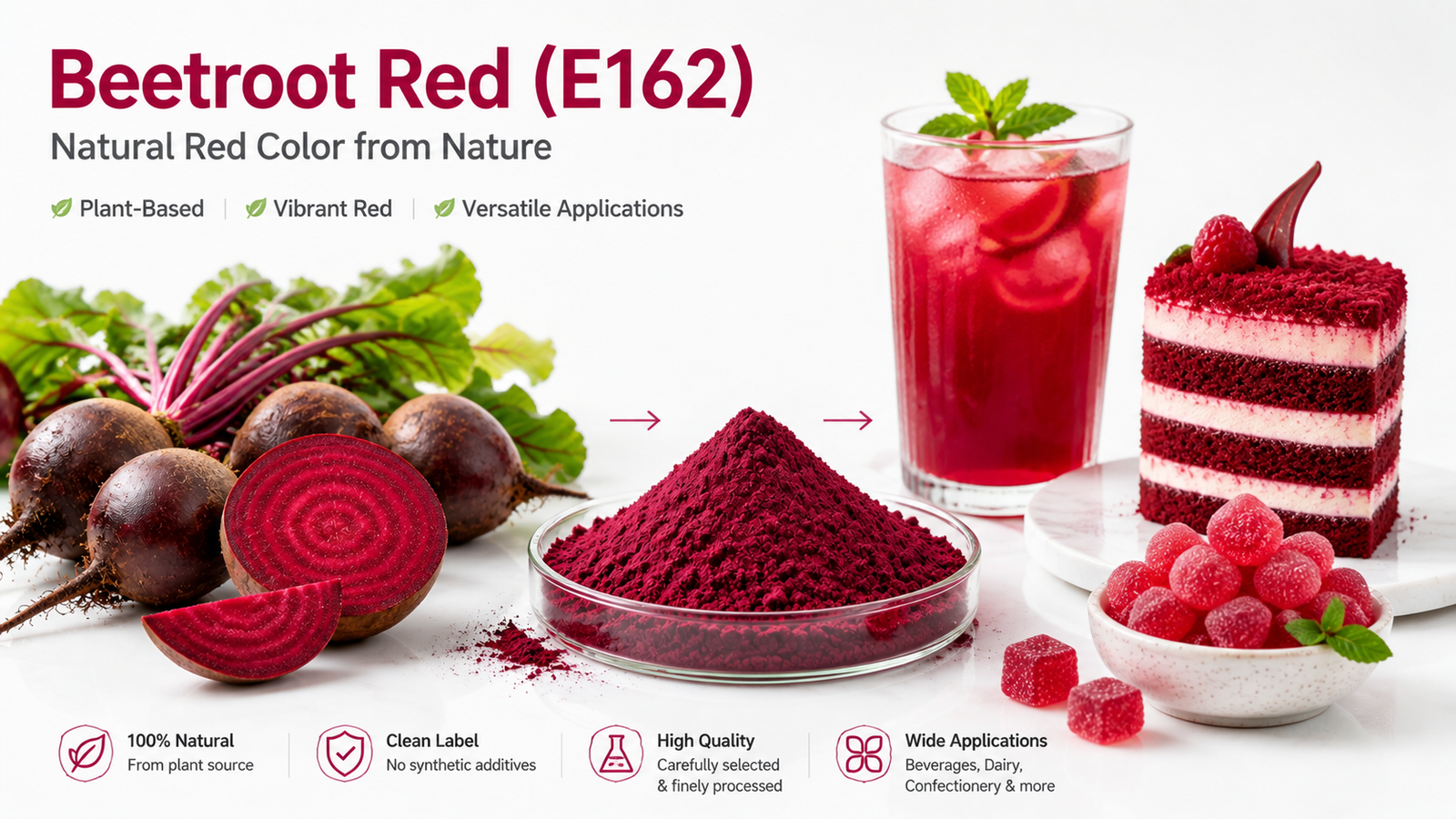
Beetroot Red E162: what formulators need to understand
Beetroot Red is a natural red food color derived from red beet (Beta vulgaris). It is widely used in food and beverage applications where manufacturers require clean-label, plant-based coloring solutions. Before adopting it, formulators need a clear picture of what the ingredient actually is, how its pigment system behaves, and where its stability limits lie. This guide is a technical decision asset — not a supplier page — to help your team evaluate Beetroot Red against your real formulation conditions.
What is Beetroot Red?
Beetroot Red is a natural coloring ingredient obtained through extraction of the pigments naturally present in red beet (Beta vulgaris). It is supplied as a water-soluble natural red color, typically as a food-grade powder, and provides a red to purplish-red shade in food and beverage formulations. E162 is the European food-color identifier assigned to beetroot red under European food additive terminology.
What are betalains?
Betalains are a family of water-soluble, nitrogen-containing pigments found naturally in red beet and a limited number of other plant sources. The betalain family is divided into two groups: betacyanins, which provide red to purple shades, and betaxanthins, which provide yellow to orange shades. The red color of beetroot comes primarily from the betacyanin group.
What is betanin?
Betanin is one specific compound within the betalain family — specifically a betacyanin — and is the principal coloring compound responsible for the characteristic red color of beetroot red extracts. In other words, betanin is a member of the betalain family, not a synonym for the whole family or for the product itself.
Relationship between Beetroot Red, betalains and betanin
These terms describe different levels of the same color system, and they are not interchangeable:
- Beetroot Red is the product — the natural coloring ingredient derived from red beet.
- E162 is the European food-color identifier for beetroot red.
- Betalains are the pigment family present in red beet that gives the extract its color.
- Betanin is the principal betacyanin compound within that family responsible for the red shade.
So Beetroot Red is a product whose color comes from betalain pigments, of which betanin is the main red coloring compound. Writing “Beetroot Red = Betanin = Betalain” as interchangeable synonyms would be inaccurate.
Why Beetroot Red stability is formulation-dependent
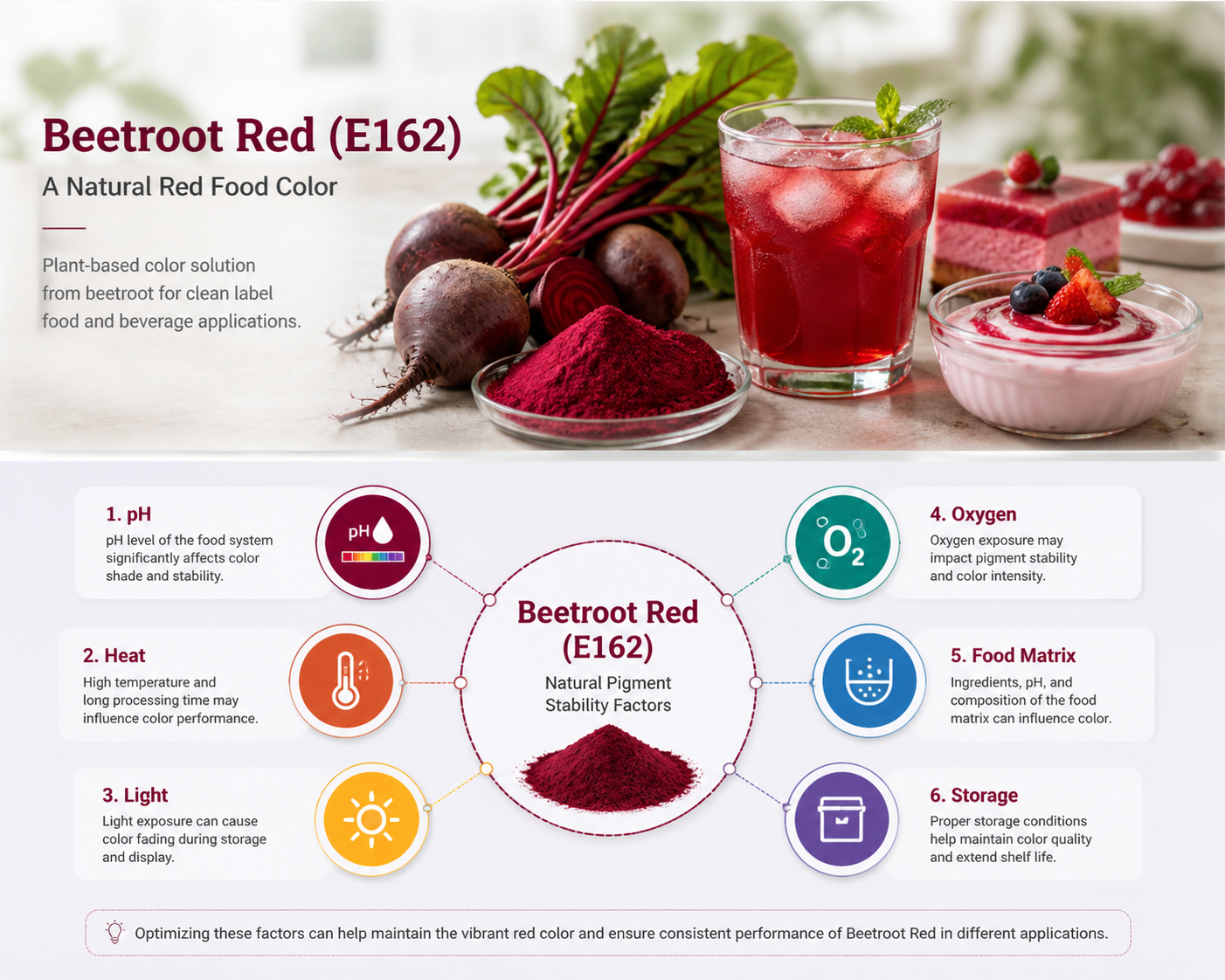
Beetroot Red stability is not a fixed property of the ingredient. Betalain pigments respond to their environment, so the same color can perform well in one product and disappoint in another. That is why stability should always be evaluated in the actual product matrix and process, not inferred from a generic data sheet. The factors below commonly interact, and a change in one can shift the behavior of the others.
- Formulation matrix
- Product pH
- Heat load and processing duration
- Light exposure
- Oxygen exposure
- Packaging
- Storage conditions
- Point of color addition
Effect of pH on Beetroot Red / betalain performance
Product pH is one of the most influential variables for betalain color performance. The shade and retention of Beetroot Red can shift across the pH range of a formulation, and the effect depends on the specific product and conditions. Rather than assuming a universal pH stability range, formulators should evaluate the color across the relevant pH window of their finished product, including any pH drift over shelf life.
Effect of heat and processing time
Heat load and processing duration both influence betalain color retention. The total time–temperature exposure matters — a lower temperature held for a long time can be as demanding as a higher temperature for a short time. Formulators should map the full thermal process (peak temperature plus total residence time) and evaluate the color against that profile. No fixed heat-resistance temperature should be assumed; a stability study in the real process is the reliable way to qualify the ingredient.
Light, oxygen, packaging and storage
Beyond pH and heat, betalain color performance is affected by conditions across the whole product life cycle:
- Light — light-transparent packaging or extended retail display under lighting can affect betalain performance.
- Oxygen — oxygen exposure during processing or in the package headspace can influence color stability; oxygen management and barrier packaging should be considered.
- Packaging — the light and oxygen barrier properties of the package shape how the color behaves over shelf life.
- Storage — temperature and humidity during distribution and storage affect retention; finished-product shelf life should be confirmed by study, not assumed.
Beetroot Red in beverages
Beetroot Red is commonly evaluated for soft drinks, juices, functional beverages and beverage bases where a water-soluble natural red to pink shade is desired. In beverage systems, formulators should assess the product pH, oxygen exposure, light transmission through the packaging and the expected shelf life. Because beverage matrices are typically low in solids and often light-exposed, betalain performance is particularly condition-dependent and should be validated in the actual drink formulation.
Beetroot Red in confectionery and gummies
Beetroot Red is evaluated for gummies, jellies, novelty confectionery, panned goods and dessert coatings. Formulators should review the thermal load during cooking and depositing, the residence time at temperature, and the final product pH. In gummy and jelly systems, the interaction between the color, the gelling system and the acidity should be checked in the real matrix, as these factors together influence the final shade and retention.
Beetroot Red in dairy and desserts
Beetroot Red may be considered for flavored dairy, yogurt and desserts where a beet-derived betalain pigment is suitable. R&D teams should evaluate matrix compatibility, acidity and processing conditions. Dairy systems vary widely in pH, fat content and heat treatment, so shade and stability should be confirmed in the specific product rather than generalized across the category.
Bakery and high-heat process considerations
Beetroot Red may be considered for bakery formulations and cereals requiring a beet-based pigment. Bakery processes often involve high heat and long bake times, which can be demanding for betalain pigments. Formulators should evaluate whether the expected heat load and residence time are compatible with Beetroot Red before qualification, and consider the addition point — for example, surface application versus inclusion in a dough or batter — as part of the evaluation.
Technical limitations — when Beetroot Red may not be the best choice
Beetroot Red is not automatically ideal for every formulation. Screening the conditions below early helps R&D teams avoid spending qualification effort on a poor fit. This section is educational screening, not a recommendation of a specific alternative — the right substitute depends on the target shade, matrix and process.
High heat load
Processes with high peak temperatures or long residence times may challenge betalain color retention. Formulators should evaluate whether the expected thermal load is compatible with Beetroot Red before qualification.
Long process duration
Extended processing at elevated temperature can compound color loss. The total time–temperature exposure, not just the peak, should be assessed.
Light exposure
Light-transparent packaging or extended display under retail lighting can affect betalain performance. Packaging and distribution conditions should be reviewed.
Oxidative conditions
Oxygen exposure during processing or in the headspace can influence color stability. Formulators should consider oxygen management and packaging barriers.
Matrix compatibility
Ingredient interactions, acidity and water activity all affect how the color behaves. The color should be evaluated in the actual product matrix, not in water alone.
Desired shade
Beetroot Red provides red to purplish-red shades. If the target shade falls outside the natural range of betalain pigments, an alternative natural red system may be more appropriate.
Formulation evaluation checklist
Use this checklist to screen a formulation before requesting samples or running a full stability study:
- Define the target shade and acceptable shade range for the finished product.
- Record the product pH and acidity profile across the shelf life.
- Map the full thermal process — peak temperature and total residence time.
- Identify light and oxygen exposure during processing, distribution and display.
- Confirm packaging type and its light/oxygen barrier properties.
- Define expected storage conditions and shelf life.
- Decide the point of color addition in the process.
- Plan a stability study in the real product matrix before qualification.
When to move from technical evaluation to product qualification
Once the formulation conditions have been screened and Beetroot Red appears technically suitable, the next step is product qualification. That means moving from desk evaluation to requesting specifications, COA and samples, and running a stability study in the actual product matrix. The Beetroot Red E162 product page is the right destination for specifications, documentation and sample requests. If the screening reveals a condition that challenges betalain performance, it is more efficient to revisit the formulation or consider the broader Natural Red Colors range before committing qualification effort.
How U.S. regulation distinguishes beet-derived color ingredients
In the United States, the FDA regulates beet-derived color ingredients under separate listings, and ingredient identity and manufacturing process matter. These categories are not interchangeable, and the correct regulatory pathway must be determined from the exact ingredient identity and how the color is produced:
| Ingredient | U.S. regulatory listing |
|---|---|
| Beetroot Red | 21 CFR §73.39 |
| Beet Powder / Dehydrated Beets | 21 CFR §73.40 |
| Beet Juice | 21 CFR §73.260 |
21 CFR §73.39 refers to a specific Beetroot Red identity produced through controlled fermentation using a genetically engineered strain of Saccharomyces cerevisiae. Regulatory applicability therefore depends on the exact ingredient identity and manufacturing process, and a conventional beet extract should not be assumed to fall under §73.39 without independent verification of the exact ingredient identity and manufacturing process. E162 is the European food-color identifier for beetroot red, not a U.S. designation, and does not itself determine the U.S. CFR classification. Always confirm the applicable conditions of use and consult your regulatory affairs team for market-specific compliance.
Frequently Asked Questions
From technical evaluation to product qualification
Ready to move from formulation screening to product qualification? The Beetroot Red E162 product page provides specifications, documentation and sample requests. Our technical team can also discuss your application and provide the documentation you need to evaluate the ingredient in your matrix.