Introduction
Creating a natural blue color for food and beverage products remains one of the more challenging tasks for formulators.
Compared with naturally derived red, yellow and orange colors, blue shades have fewer available natural sources and often require more careful evaluation of formulation conditions.
For food manufacturers, selecting a natural blue food color is not simply about finding the brightest shade.
The final color performance may depend on:
- pH conditions
- processing temperature
- heating time
- food matrix
- packaging
- light exposure
- storage conditions
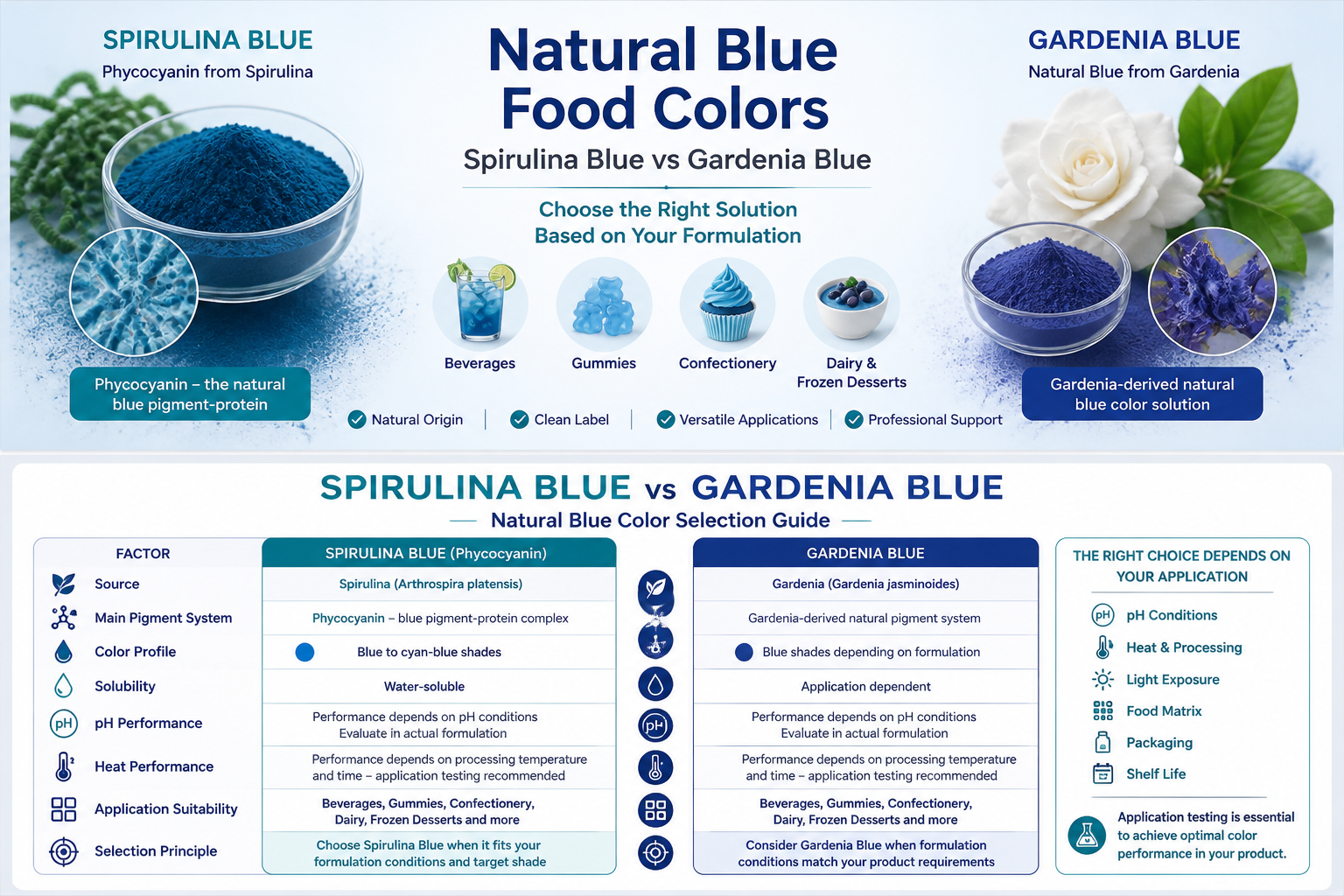
Two commonly discussed natural blue coloring solutions are Spirulina Blue (Phycocyanin) and Gardenia Blue.
Both can provide attractive natural blue shades, but they are based on different pigment systems and may perform differently depending on the application.
The most suitable choice is not necessarily one universal solution.
The right natural blue color depends on the actual formulation requirements.
Spirulina Blue (Phycocyanin)
Spirulina Blue is a naturally derived blue coloring ingredient associated primarily with phycocyanin, a blue pigment-protein obtained from spirulina.
Manufacturers evaluating Spirulina Blue should consider pH, processing temperature, light exposure, ingredient compatibility and packaging conditions.
Internal Link:
Gardenia Blue
Gardenia Blue is another naturally derived blue coloring solution considered by food manufacturers.
Its performance depends on formulation environment, target shade, processing conditions, ingredient interactions and storage requirements.
Spirulina Blue vs Gardenia Blue: Key Differences
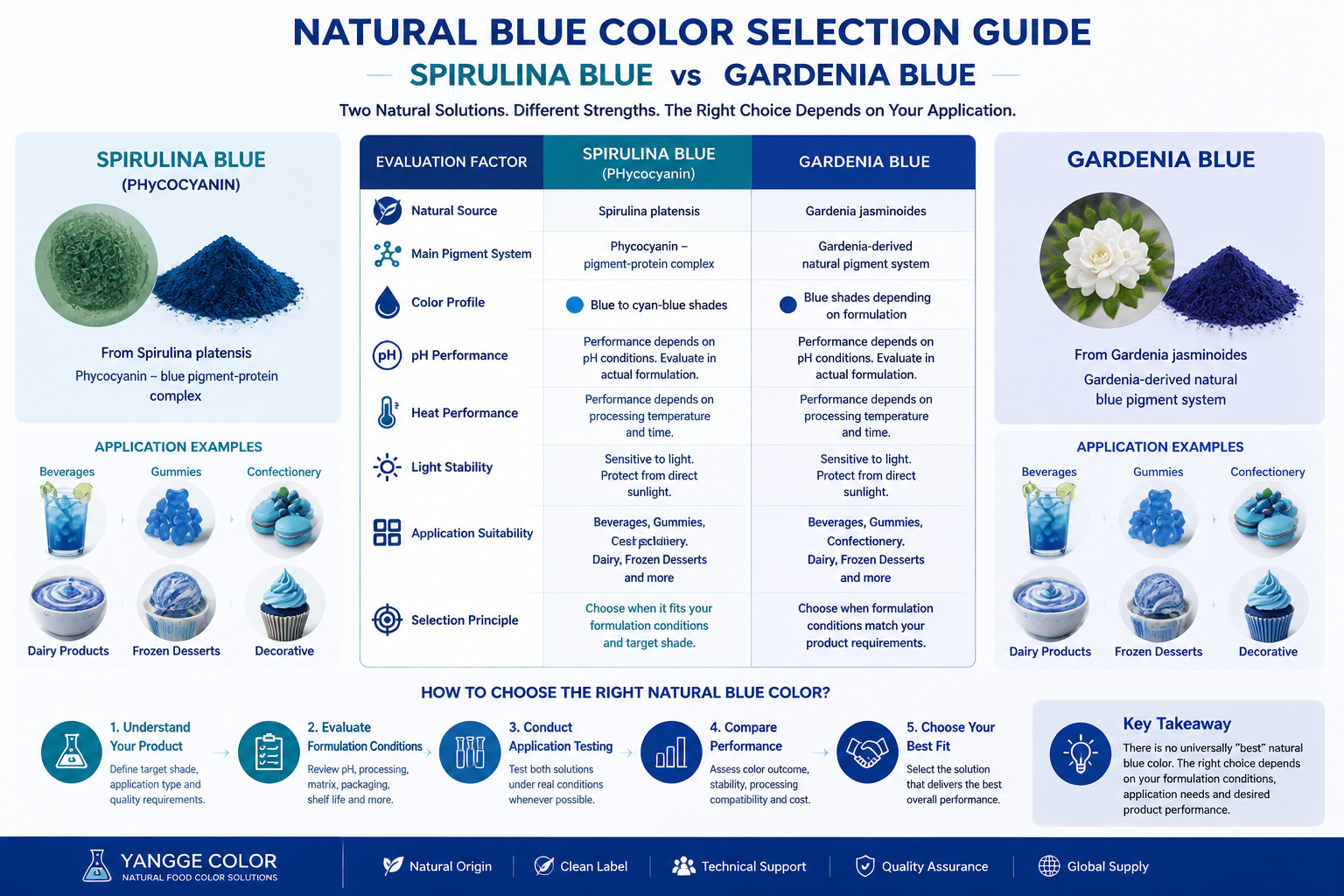
The most important consideration is choosing the ingredient that performs best under actual manufacturing and storage conditions.
Selecting a Natural Blue Food Color Supplier
Manufacturers should evaluate:
- COA
- TDS
- Product Specification
- MSDS/SDS
- Allergen Statement
- Non-GMO Statement
- Halal
- Kosher
- HACCP
- ISO-related documentation
Yangge Color supports food and beverage manufacturers with natural color ingredients and technical documentation.
Frequently Asked Questions
Need Help Selecting a Natural Blue Food Color?
Yangge Color can help evaluate suitable natural color solutions based on your formulation requirements.
References & Resources
The following authoritative resources provide general information about natural blue colors, phycocyanin, and gardenia-derived pigments.
- EFSA (European Food Safety Authority) — Colouring Foods Overviewhttps://www.efsa.europa.eu/
- PubChem — Phycocyaninhttps://pubchem.ncbi.nlm.nih.gov/
- Journal of Food Science — Natural Blue Pigments: Sources, Properties and Applicationshttps://ift.onlinelibrary.wiley.com/
- Food Hydrocolloids — Phycocyanin Stability Researchhttps://www.sciencedirect.com/
- Food Chemistry — Gardenia-Derived Blue Pigments Researchhttps://www.sciencedirect.com/
- FAO/WHO — Food Additives and Natural Colouring Resourceshttps://www.fao.org/