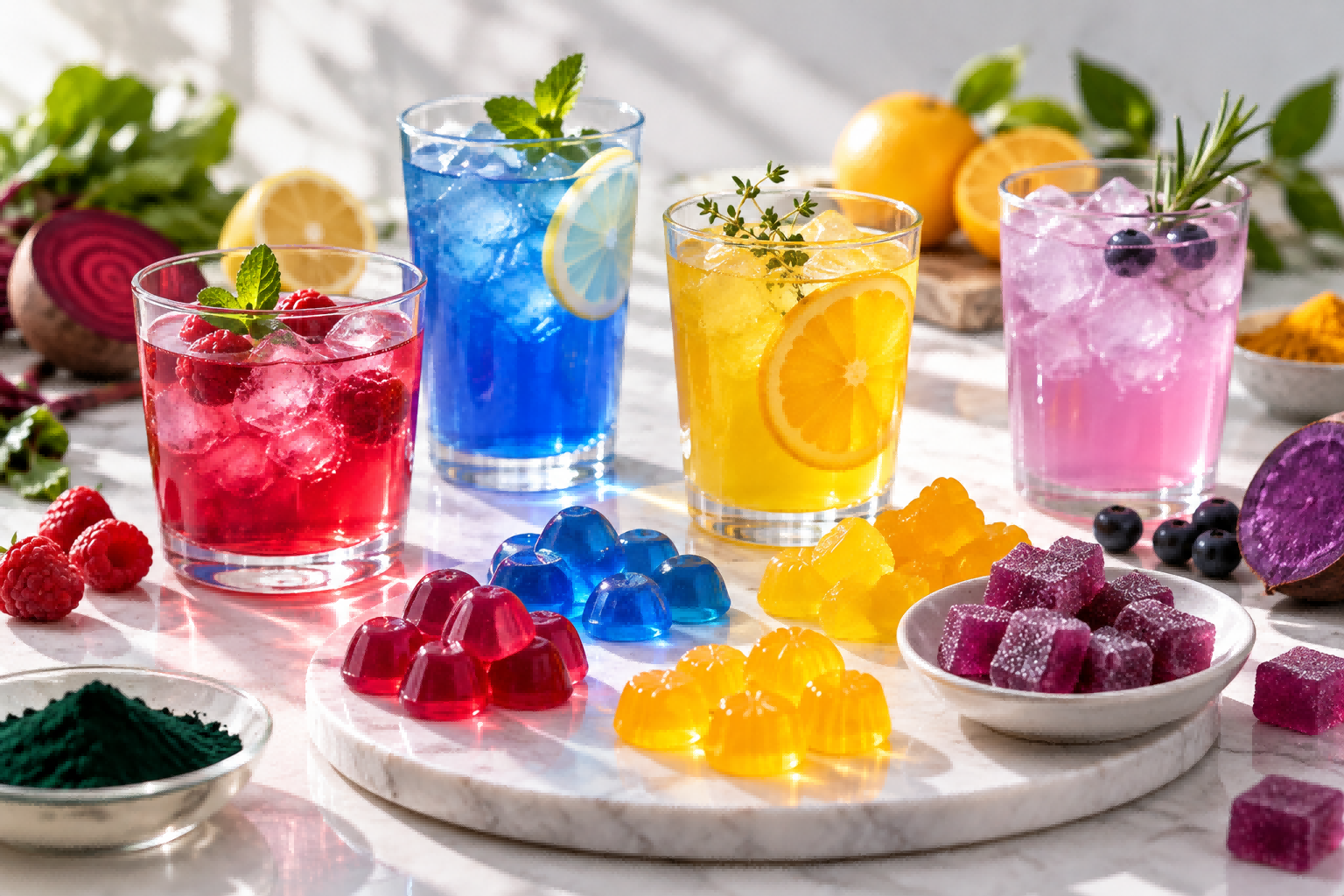
What Is Spirulina Blue?
Spirulina Blue is a natural blue coloring ingredient derived from Arthrospira platensis (spirulina), with phycocyanin as the principal blue coloring component.
It is supplied as a food-grade blue powder for consistent dosing and integration into dry and wet formulations. Because phycocyanin is water soluble, Spirulina Blue is particularly relevant to water-based food and beverage systems.
For commercial sourcing, grades, specifications and documentation, see the Spirulina Blue product page. This guide focuses on the formulation science behind using it.
What Is Phycocyanin?
Phycocyanin is the principal blue pigment-protein complex responsible for the characteristic blue color of Spirulina Blue extracts.
Unlike many conventional small-molecule food pigments, phycocyanin is a protein-associated pigment system. This structural characteristic helps explain both its attractive blue appearance and its sensitivity to environmental factors such as temperature, pH and light.
For formulators, this means phycocyanin should be evaluated not only as a source of color but as an ingredient whose final performance depends on the conditions encountered during manufacturing and storage.
Why Spirulina Blue Is Technically Different from Many Natural Colors
Many natural food colors are small-molecule pigments whose behavior is governed mainly by concentration and pH. Phycocyanin behaves differently because it is a pigment-protein.
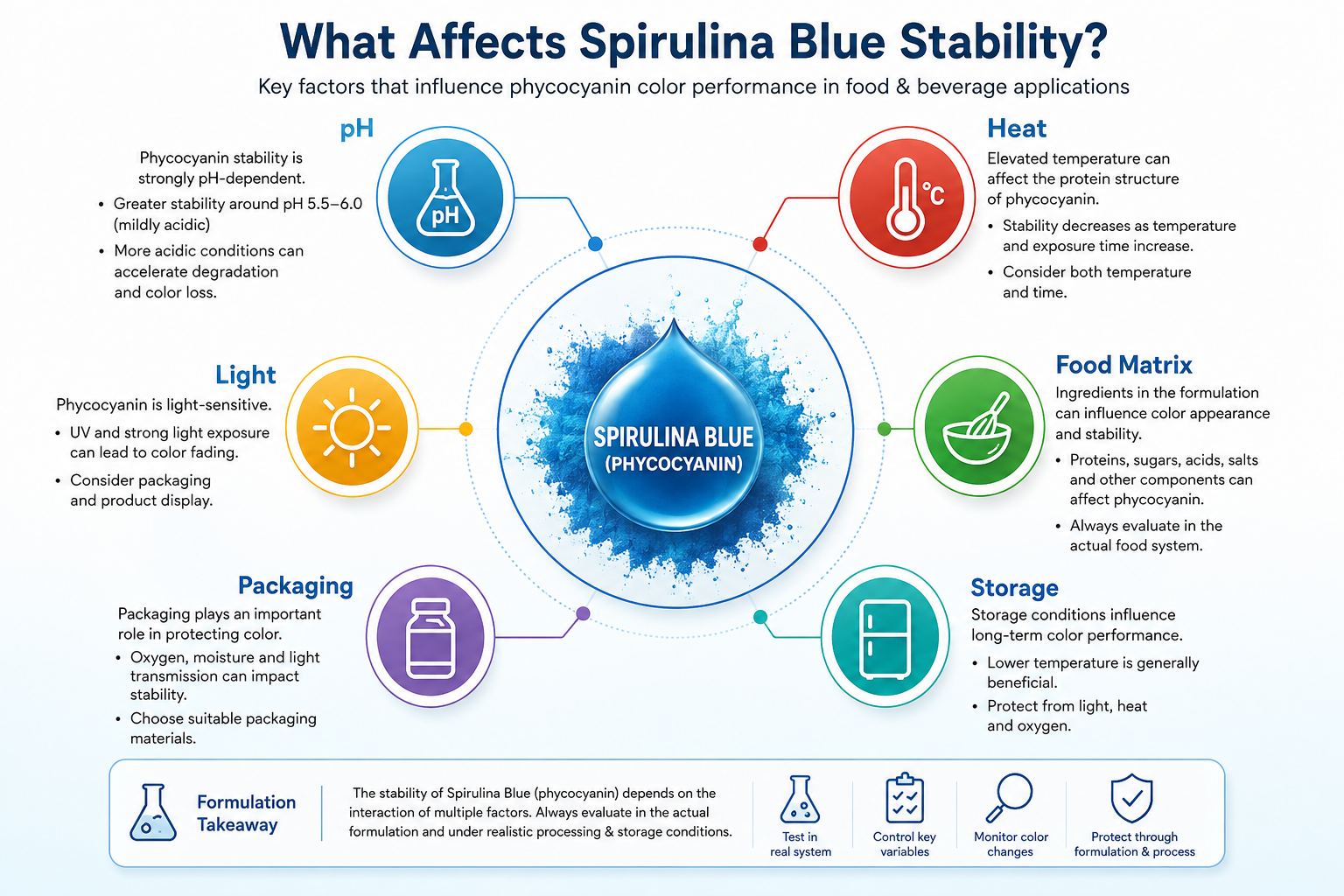
This protein nature means that formulation sensitivity can be higher than for some other natural colors. The variables that most often influence final color performance include:
- thermal exposure during processing;
- formulation pH and acid addition;
- light exposure across the product lifecycle;
- the addition point within the process;
- packaging transparency and barrier properties; and
- storage temperature and duration.
The practical consequence is that Spirulina Blue should be validated in the actual food matrix and under realistic processing and storage conditions, rather than selected from a powder sample or theoretical dosage alone.
Key Formulation Variables
The table below summarizes the variables R&D most often evaluates when working with Spirulina Blue. The wording is deliberately conditional — actual performance depends on the specific formulation and process.
pH Considerations
pH is one of the most important formulation variables affecting phycocyanin color performance.
Final color performance can depend on formulation pH, and the complete matrix should be evaluated rather than water alone. Acids may influence final color behavior, so beverage and confectionery systems should be tested in the actual formulation.
Published research indicates that phycocyanin stability is pH-dependent, with many studies reporting better stability under mildly acidic to near-neutral conditions, while strongly acidic environments may create greater stability challenges. A single pH value should not be treated as a universal specification for every commercial ingredient or finished food.
A Practical Formulation Question
Before selecting Spirulina Blue, ask:
What is the actual pH of the finished product, and how will that pH interact with processing and storage conditions?
This is often more useful than asking whether a natural blue color is generically “acid stable.”
Important distinction: The commercial E18 product pH of 5.0–6.5 describes the product itself and is a product specification. It is not an application stability range. Final application suitability depends on the formulation matrix and must be evaluated in the actual product.
Heat & Processing Considerations
Phycocyanin should generally be treated as heat-sensitive. Thermal load — not temperature alone — is what matters.
Because phycocyanin is a protein-associated pigment, elevated temperature can affect color performance. R&D should evaluate the complete thermal picture:
- process temperature;
- exposure time at that temperature;
- the addition point — when the color encounters heat;
- holding time after addition; and
- any post-addition heat exposure (for example, a second heating step).
A formulation exposed to moderate heat for a short period may behave differently from one subjected to prolonged heating or a high-temperature process. Where the manufacturing process permits, formulators may evaluate whether the color can be incorporated at a stage that reduces unnecessary thermal exposure. Any processing strategy should be validated in the actual formulation.
Light & Storage Considerations
Light exposure can influence phycocyanin color stability, making packaging and storage conditions relevant to long-term color performance.
When developing a product with Spirulina Blue, manufacturers should consider the complete product lifecycle:
Processing → Filling → Packaging → Distribution → Retail Display → Consumer Storage
A formulation that looks excellent immediately after production may not necessarily maintain exactly the same shade throughout its intended shelf life. Useful development evaluations can therefore include light exposure, packaging transparency, storage temperature, oxygen exposure, formulation interactions, and color change over the intended storage period.
Addition Point & Process Timing
The point at which Spirulina Blue is added can influence final color performance. Addition point can affect:
- total heat exposure — adding later may reduce thermal load;
- mixing efficiency and color distribution;
- acid exposure — adding before or after an acid step changes the pH at contact; and
- final appearance in the finished matrix.
There is no single universal process. The optimal addition point should be determined in the actual production process, comparing candidate addition stages against the target shade and stability outcome.
Packaging Considerations
This section concerns the finished product packaging — not the raw material packaging. Packaging choices can influence how Spirulina Blue performs over shelf life.
Technical considerations for finished-product packaging include:
- light exposure — transparent packaging increases light exposure versus light-protective packaging;
- oxygen and environmental exposure — barrier properties can influence long-term performance;
- storage conditions the package will experience; and
- final product format — liquid, semi-solid, or solid systems interact with packaging differently.
Packaging should be evaluated together with the expected retail display and consumer storage conditions, not in isolation.
Beverage Formulation
Beverages are an important application area because Spirulina Blue is compatible with water-based systems. However, beverage formulators should pay particular attention to pH, thermal process, acid addition, light exposure, packaging, storage, product clarity and the addition point.
Highly acidic formulations may present greater stability challenges, while transparent packaging can increase light exposure. Application testing under realistic filling and storage conditions is therefore important.
Beverage R&D Checklist
- What is the finished beverage pH?
- What thermal process (pasteurization, hot-fill, retort, cold-fill) is applied?
- Where is the color added relative to heat and acid steps?
- Is the packaging transparent or light-protective?
- What shelf life and storage temperature are expected?
- Does the beverage require high clarity, and how does the color appear at target dosage?
Beverage suitability is not universal — it should be confirmed in the actual formulation.
Gummies & Confectionery
Gummies and confectionery are visually driven products, making blue, turquoise and blended green shades commercially interesting. When evaluating Spirulina Blue for these applications, formulators should consider:
- the heating step and its temperature;
- acid addition and final formulation pH;
- addition timing — when the color is added relative to heat and acid;
- the target shade and dosage in the actual matrix; and
- storage stability of the finished product.
Bench testing can help determine whether the target shade remains acceptable after processing and during storage. Gummy stability is not guaranteed and should be validated in the specific formulation.
Dairy & Frozen Desserts
Selected dairy and dairy-style applications can provide suitable environments for Spirulina Blue when formulation conditions are compatible with phycocyanin. Frozen desserts are attractive because they often involve lower storage temperatures after processing.
Formulators should evaluate:
- the dairy matrix — proteins, fat and sugars can influence appearance;
- mixing and how the color incorporates into the system;
- shade development against the natural base color (a white base produces a different shade from a yellowish one);
- process exposure — any heat treatment before freezing; and
- storage conditions and shelf life.
Bakery / Higher-Heat Applications
Bakery applications require more careful evaluation because high-temperature baking can be challenging for heat-sensitive phycocyanin. Spirulina Blue should not be assumed to be universally suitable for baking.
Rather than asking “Can Spirulina Blue be used in bakery?”, a more useful formulation question is:
At what stage of this bakery application will the color be exposed to heat?
Spirulina Blue may be more suitable for selected post-bake decorations, fillings, icings, coatings or other components that experience less severe thermal exposure than the baked product itself. These are formulation concepts to evaluate, not guaranteed solutions — each should be validated in the actual application.
Common Formulation Problems
The troubleshooting table below covers issues formulators may encounter when working with Spirulina Blue. The guidance is diagnostic, not prescriptive — each situation should be evaluated in the actual product.
Spirulina Blue vs Gardenia Blue — Quick Selection
Spirulina Blue and Gardenia Blue are both natural blue options, but they should not be treated as interchangeable. Their pigment systems, formulation behavior and application suitability differ.
R&D should compare another natural blue option when the formulation environment — for example, a strongly acidic beverage — or the desired shade presents challenges for phycocyanin. The more suitable color is the one that performs appropriately in the actual formulation, process and target market.
For the full technical comparison, see our dedicated Spirulina Blue vs Gardenia Blue article, and the Gardenia Blue product page for product details.
Commercial Product Reference
This compact reference summarizes verified commercial facts for Yangge Color's Spirulina Blue Natural Color. It is provided as a bridge to commercial evaluation — the technical focus of this guide remains formulation. For full product details, see the Spirulina Blue product page.
Technical Product
Spirulina Extract
Source
Arthrospira platensis
Principal Coloring Component
Phycocyanin
Available Grades
E6 / E10 / E18 / E25 / E40
Detailed Verified Reference
E18
Form
Blue powder
Product pH
5.0–6.5 (product specification, not application stability range)
Solubility
100% water soluble
MOQ
10 kg
Packaging
5 kg/bag + 10 kg/carton
Lead Time
Approx. 5 days for 1,000 kg
Documents
COA / TDS / SDS / Specification available on request
Product pH vs Application Performance: The product pH of 5.0–6.5 is a product specification that describes the ingredient itself. It is not an application stability range. Final application suitability depends on the formulation matrix, processing and storage conditions, and must be evaluated in the actual product.
R&D Evaluation Checklist
Use this checklist before selecting Spirulina Blue and before commercial scale-up. Each question should be answered against the actual product and process.
The key principle: evaluate Spirulina Blue in the real formulation and under realistic processing and storage conditions.